Bargains! PROMOTIONS


Robert Scholz, MA,LMFT, LPCC, founder of The Change Place, Inc., is a marriage and family therapist and professional clinical counselor. He is well-known for his work as a trainer and consultant in assisting schools and communities prepare for and respond to major crisis events like wildfires, mass shootings, and suicides. A member of the Motivational Interviewing Network of Trainers, Robert has trained thousands in motivational interviewing skills and other evidence-based therapeutic approaches. He has authored publications on disaster mental health, addiction treatment, threat assessment, and men’s mental health. Susan R. Hall, JD, PhD, is a tenured associate professor of psychology at Pepperdine University’s Graduate School of Education and Psychology. She has published and presented nationally on topics related to clinical/counseling practice and training; trauma and positive psychology; and psychology, public policy and law, including two APA books: Courtroom Modifications for Child Witnesses and Laws Affecting Clinical Practice. Dr. Hall served on the editorial board of the Journal of Youth and Adolescence, was treasurer for APA’s Society for Child and Family Policy and Practice (Division 37), and received Pepperdine’s Howard A. White Award for Excellence in Teaching. Brian Van Brunt, EdD, is director of behavior and threat management for D-Prep Safety and the president of the Workplace Violence Prevention Association. Author of over a dozen books, Brian has worked as a child and family therapist, university professor, assistant deputy director of training at Secure Community Network, and president of the National Association for Behavioral Intervention and Threat Assessment. He is an internationally recognized expert in behavioral intervention, threat assessment, crisis preparedness, mental illness, and instructional design. Brian has provided consulting services to schools around the world on student mental health, counseling, campus violence, and behavioral intervention. Alexandre Vaz, PhD, is cofounder and chief academic officer of Sentio University and the Sentio Counseling Center. He provides workshops, webinars, and advanced clinical training and supervision to clinicians around the world. Dr. Vaz is the author/coeditor of over a dozen books on deliberate practice and psychotherapy training. He has held multiple committee roles for the Society for the Exploration of Psychotherapy Integration (SEPI) and the Society for Psychotherapy Research (SPR). Dr. Vaz is founder and host of Psychotherapy Expert Talks, an acclaimed interview series with distinguished psychotherapists and therapy researchers. Tony Rousmaniere, PsyD, is cofounder and program director of Sentio University and the Sentio Counseling Center. He provides workshops, webinars, and advanced clinical training and supervision to clinicians around the world. Dr. Rousmaniere is the author/coeditor of many books on deliberate practice and psychotherapy training. In 2017, he published the widely cited article in The Atlantic Monthly, “What Your Therapist Doesn’t Know.” Dr. Rousmaniere supports the open-data movement and publishes his aggregated, deidentified clinical outcome data on his website (https://drtonyr.com/). Dr. Rousmaniere is past president of the American Psychological Association’s Division 29 (the Society for the Advancement of Psychotherapy).
""I'm thrilled to see the publication of Deliberate Practice in Assessing Self-Directed Violence. Why? Because for decades we've needed a text with clear guidance to help students and practitioners develop skills for assessing self-directed violence (aka suicide assessment). Now we have it. This book moves training and practice in assessing self-directed violence to the next level."" - John Sommers-Flanagan, PhD, Director, Center for the Advancement of Positive Education, University of Montana, Missoula, and coauthor of Clinical Interviewing ""Finally, a book that bridges the gap between a therapist's knowledge of self-directed violence and how to use that knowledge during times it matters most. What sets this book apart is the shift in mindset, from the assumption therapists get better over time to the fact that intentional training and repetition through deliberate practice is what's needed to bridge the gap between ""I know this"" and ""I nailed it."""" - Lisa Pescara-Kovach, PhD, Director, Center for Education in Mass Violence and Suicide; Professor, Educational Studies, The University of Toledo, Toledo, OH; and coauthor of White Supremacist Violence: Understanding the Resurgence and Stopping the Spread ""This book provides a clear, evidence-informed framework for training graduate students to competently assess and treat self-directed violence. It translates complex risk assessment concepts into practical, ethical decision-making tools that are accessible without oversimplifying the seriousness of high-risk situations. Through case examples, structured exercises, and step-by-step guidance, the text builds therapist confidence while emphasizing safety, supervision, and collaboration. A major strength is its explicit focus on reducing the trepidation and unease commonly experienced by both trainees and practicing clinicians when outcomes may be severe or life-threatening. Overall, the book meaningfully increases clinical competency and readiness, making it a valuable resource for graduate education and ongoing professional development."" - David J. Denino, MS, LPC, Director Emeritus, Counseling Services, Southern Connecticut State University, New Haven, and Disaster Mental Health Lead for CT/RI, American Red Cross
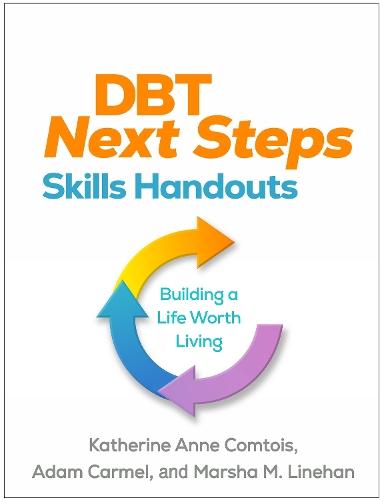
DBT Next Steps Skills Handouts
Building a Life Worth Living
Paperback
$92.99
Forthcoming
You can preorder this
Essentials of Compassion Focused...
A Practice Manual for Clinicians...
Paperback
$67.99
Forthcoming
You can preorder this
Train Your Brain to Beat Chronic...
How to Harness the Power of the...
Paperback
$41.99
Forthcoming
You can preorder this
Working Relationally with Young...
A Cognitive Analytic Approach to...
Paperback
$89.99
Forthcoming
You can preorder this