Bargains! PROMOTIONS

Close Notification

Your cart does not contain any items

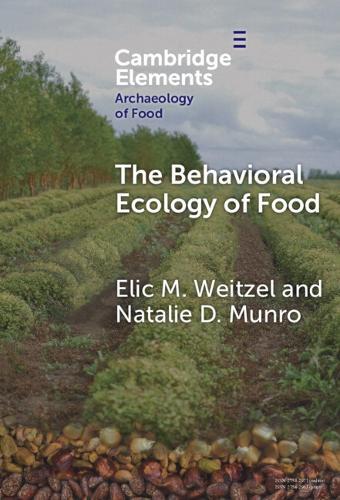
The Behavioral Ecology of Food

Bridging the Archaeological and the Contemporary

Elic M. Weitzel (Smithsonian National Museum of Natural History) Natalie D. Munro (University of Connecticut)

$54.95   $46.83

Paperback

Not in-store but you can order this
How long will it take?

QTY:

English
Cambridge University Press
19 February 2026
Due to the multi-faceted nature of food – as sustenance, symbol, and commodity – diverse theoretical perspectives have been used to study it in archaeology. One of the more influential and versatile of these approaches is behavioral ecology: the study of behavioral adaptation to local environments. Behavioral ecology provides a powerful body of theory for understanding human decision-making in both the past and present. This Element reviews what behavioral ecology is, how it has been used by archaeologists to study decision-making concerning food and subsistence, how it articulates with other ecological approaches, and how it can help us to better understand sustainability in our contemporary world. The use of behavioral ecology to bridge the archaeological and the contemporary can not only explain the roots of important behavioral processes, but provide potential policy solutions to promote a more sustainable society today.
By:   ,
Imprint:   Cambridge University Press
Country of Publication:   United Kingdom
Weight:   131g
ISBN:   9781009273442
ISBN 10:   1009273442
Series:   Elements in the Archaeology of Food
Pages:   80
Publication Date:  
Audience:   General/trade ,  ELT Advanced
Format:   Paperback
Publisher's Status:   Active
1. Introduction; 2. What is behavioral ecology?; 3. The limits of behavioral ecology; 4. Sustainable fisheries: a case study; 5. Conclusions; References.

See Also