Beat the rise! Delivery fees are going up soon.


Ruth Rendell was an exceptional crime writer, and will be remembered as a legend in her own lifetime. Her groundbreaking debut novel, From Doon With Death, was first published in 1964 and introduced the reader to her enduring and popular detective, Inspector Reginald Wexford, who went on to feature in twenty-four of her subsequent novels. With worldwide sales of approximately 20 million copies, Rendell was a regular Sunday Times bestseller. Her sixty bestselling novels include police procedurals, some of which have been successfully adapted for TV, stand-alone psychological mysteries, and a third strand of crime novels under the pseudonym Barbara Vine. Very much abreast of her times, the Wexford books in particular often engaged with social or political issues close to her heart. Rendell won numerous awards, including the Crime Writers' Association Gold Dagger for 1976's best crime novel with A Demon in My View, a Gold Dagger award for Live Flesh in 1986, and the Sunday Times Literary Award in 1990. In 2013 she was awarded the Crime Writers' Association Cartier Diamond Dagger for sustained excellence in crime writing. In 1996 she was awarded the CBE and in 1997 became a Life Peer. Ruth Rendell died in May 2015. Her final novel, Dark Corners, was published in October 2015.
Rendell just keeps getting better and better. A Judgment in Stone (1977) was a tour de force in her crime-from-the-criminal-point-of-view mode. A Sleeping Life (1978) brought back Inspector Wexford at his best. And now, without losing an iota of the understated, unsentimental crispness that is her trademark, she expands slightly beyond the mystery/crime genre: this new story has a double plot a bit reminiscent of Victor Canning, and it exudes a warmth rarely found in Rendell-land. The launchpad for both plot lines is a pathetic bank robbery in a Suffolk village. The two young misfits who rob the bank at lunchtime do get away with 4000 pounds, but they must also take with them homely, busty teller Joyce - who has seen their faces. (Their stocking masks get drenched in the rain.) While the panicky robbers and surly prisoner Joyce set up an impossible, awful, sexless menage a trois in a seedy London suburb, someone else is, on the other hand, enjoying himself: bank-manager Alan Groombridge, unhappily married and a bookish daydreamer, was watching the robbery while hiding in a closet (fondling 3000 pounds in bank cash as was his wont), and he has grabbed the opportunity to run away to London with his small fortune - the police, et al., believe him to have been kidnapped along with Joyce. So Rendell cuts back and forth from the increasingly grim state of affairs at the robbers' fiat (one of them is coming clown with hepatitis, the other's gone round the bend) to Alan's rebirth in the nicest neighborhoods in London - new name, new home, and miraculous new love. But. . . Alan feels guilty about running away, about not helping the police to find poor kidnapped Joyce - so when he accidentally stumbles on the trail of the robbers, he must follow that trail and try to locate Joyce himself. The dark comedy and bright romance here quickly shift to taut drama and tragedy - but Rendell supports every jolt of suspense with dazzling shorthand characterization and detail-perfect atmosphere. A can't-stop-reading, humanized melodrama that could also be, in the right hands, the makings of a gem of a movie. (Kirkus Reviews)
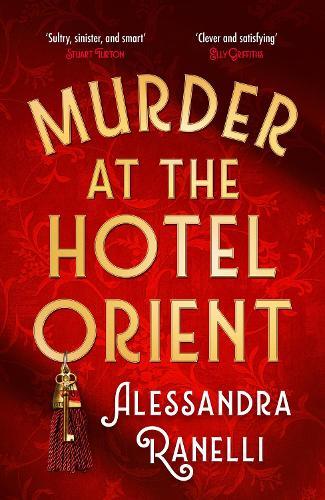
Murder at the Hotel Orient
A Spicy Whodunnit Sunday Times bestseller...
Paperback
$34.99
In Stock 😊