Bargains! PROMOTIONS


Dr. Omid Rahmati is a geo-environmental researcher and Assistant Professor at the Agricultural Research, Education, and Extension Organization (AREEO) in Iran. His research focuses on applying machine learning models to natural hazard mitigation and watershed management. He has authored and co-authored over 70 articles in international peer-reviewed journals, as well as several books and book chapters. Dr. Rahmati’s publications have been cited more than 12,500 times (H-index: 56), and he has been recognized as a Highly Cited Researcher. He is ranked among the World’s Top 1% of Scientists by Web of Science (Clarivate, 2021–2022) and listed in Stanford University’s “World’s Top 2% Scientists from 2021 to 2025. His publications over the past decade reflect a broad and significant influence in his field. Dr. Assefa M. Melesse is a Distinguished University Professor of Water Resources Engineering at Florida International University. He earned his ME (2000) and PhD (2002) from the University of Florida in Agricultural Engineering. His areas of research and experience include climate change impact modeling, watershed modeling, ecohydrology, sediment transport, surface and groundwater interactions modeling, water–energy–carbon fluxes coupling and simulations, remote sensing hydrology, river basin management, and land cover change detection and scaling. Dr. Melesse is a registered Professional Engineer (PE), Board Certified Enviromental Engineer (BCEE) and also a Board Certified Water Resources Engineer (BC.WRE) with over 30 years of teaching and research experience, and has authored/edited 11 books, over 230 journal articles, and over 100 book chapters. Dr. Amir Naghibi is an Assistant Professor in the Division of Water Resources Engineering and the Center for Advanced Middle Eastern Studies at Lund University, Lund, Sweden. His work sits at the intersection of artificial intelligence (AI), computer science, remote sensing, and environmental systems modeling, addressing the water-climate-food-energy nexus. He develops advanced AI-driven decision support systems to address complex challenges in water resources, agriculture, climate adaptation, and natural hazard management. He has published more than 50 papers in peer-reviewed journals with over 6,000 citations and has been listed in Stanford University’s World’s Top 2% Scientists from 2020 to 2025, demonstrating his broad and significant scientific influence.
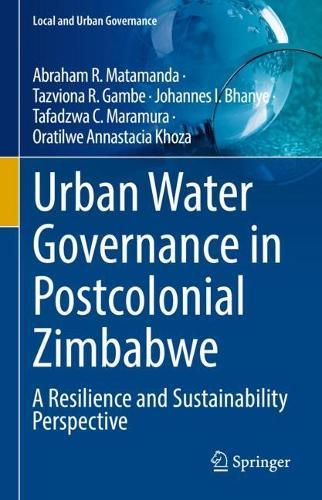
Urban Water Governance in Postcolonial...
A Resilience and Sustainability...
Hardback
$385.95 $308.92
Not in-store but you can order this
Greening Water Risks
Natural Assurance Schemes
Paperback
$95.95 $81.81
Not in-store but you can order this
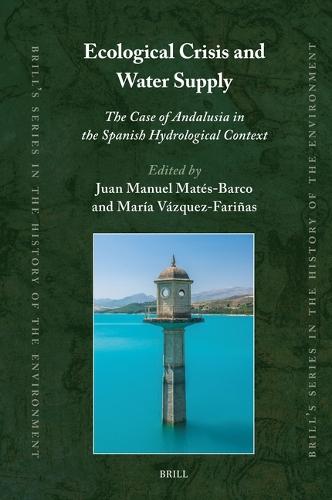
Ecological Crisis and Water Supply...
The Case of Andalusia in the Spanish...
Hardback
$440.95 $352.85
Not in-store but you can order this
Indigenous Water and Drought Management...
Paperback
$292.95
Not in-store but you can order this
Water Resources Management
Innovative and Green Solutions
Paperback
$198.95 $158.78
Not in-store but you can order this
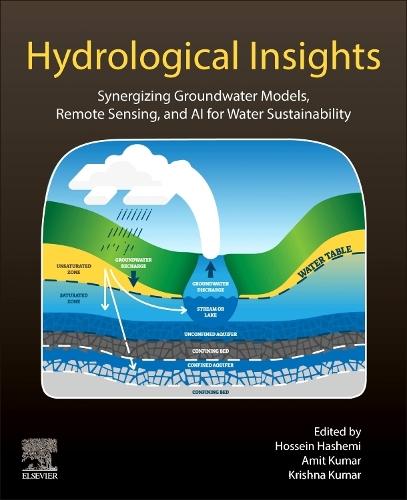
Hydrological Insights
Synergizing Groundwater Models,...
Paperback
$318.95
Not in-store but you can order this