Bargains! PROMOTIONS


Lucia Motolinia is an Assistant Professor in the Department of Political Science at Washington University in St. Louis. Her research focuses on the intricate dynamics of electoral institutions, legislative behavior, and money in politics. Her work has appeared in leading journals including The American Political Science Review, American Journal of Political Science, British Journal of Political Science, and World Politics, among others.
'Lucia Motolinia thinks through what motivates legislators, what motivates parties, and how these motivations map onto political behavior more thoroughly and systematically than any previous scholarship. Then, having shifted our expectations, she tests her ideas against hard evidence from Mexican politics. This is exemplary scholarship.' John M. Carey, Wentworth Professor in the Social Sciences, Dartmouth College 'In this masterful study Lucia Motolinia shows how, paradoxically, electoral reforms that give representatives an incentive to cultivate a personal vote can coexist with continued strong party unity. With an abundance of data and a thoughtful research design this study has broad implications for our understanding of electoral politics in Mexico and beyond.' David Stasavage, Dean for the Social Sciences and Julius Silver Professor, New York University 'Investigating the real-world 'experiment' of the removal of the one-term limit in Mexico, and applying a range of advanced data analysis methods, Lucia Motolinia shows how re-election can incentivise politicians to deliver particularistic rather than policy goods. This is a foundational finding, as it challenges standard assumptions in political science. A must-read for scholars and democratic designers alike.' Simon Hix, Stein Rokkan Chair in Comparative Politics, European University Institute
American Political Parties and Elections...
A Very Short Introduction
Paperback
$24.95
In Stock 😊
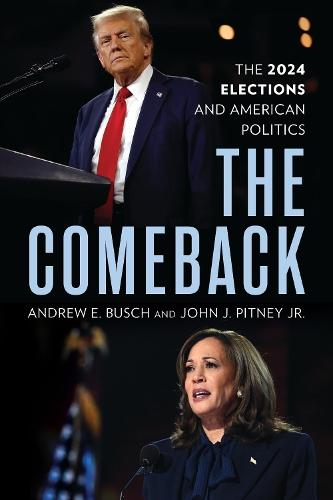
The Comeback
The 2024 Elections and American...
Hardback
$130
Not in-store but you can order this
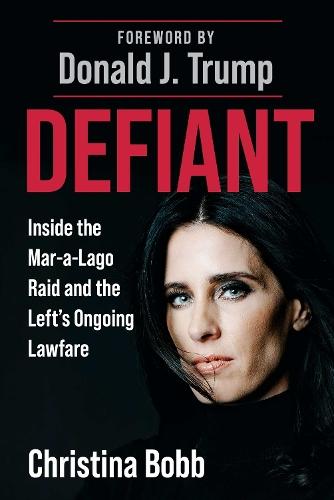
Defiant
Inside the Mar-a-Lago Raid and the...
Hardback
$59.99
Not in-store but you can order this