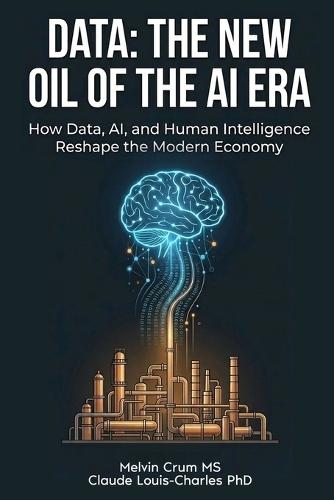
Most organizations didn't decide to become ""AI organizations."" It crept up on them. This book is the practical, strategic playbook for leaders who must turn that accidental reality into a deliberate advantage. The Symbiotic Relationship Between FHIR and AI explains why artificial intelligence in healthcare succeeds only when paired with the right data architecture, governance, and human oversight-and it shows exactly how to build those foundations so AI delivers measurable clinical, operational, and financial value.
This is not a technical manual for data scientists, nor a marketing brochure for vendors. It is a manager's guide: clear, evidence-based, and relentlessly practical. The book opens by diagnosing the real problem: healthcare produces enormous volumes of data, but that data is fragmented, inconsistently coded, and often inaccessible when decisions must be made. It then makes a simple but powerful claim: FHIR (Fast Healthcare Interoperability Resources) is the missing link that converts scattered clinical records into structured, machine-readable intelligence, and Human-in-the-Loop (HITL) governance is the mechanism that keeps AI aligned with clinical judgment. As the book states, HITL ensures that humans ""actively review, validate, override, and improve"" AI decisions.
Readers will find a concise primer on FHIR's core concepts-Resources, terminology bindings (LOINC, SNOMED CT, RxNorm), and RESTful APIs-paired with actionable guidance on how to prioritize and implement FHIR endpoints across an enterprise. The book explains why legacy standards and document-centric approaches fail modern AI pipelines, and it provides a step-by-step framework for reducing the 3:1 data-preparation burden that typically consumes AI projects. Practical checklists help leaders inventory data assets, map clinical concepts across systems, and set realistic timelines for interoperability work.
Security, trust, and governance receive equal attention. The book demystifies OAuth and OpenID Connect in plain language, shows how SMART on FHIR enables an app ecosystem, and lays out governance patterns that scale oversight without creating bottlenecks. Real-world case studies-sepsis prediction, NLP for social determinants, patient matching, and administrative automation-illustrate common failure modes and the concrete fixes that prevent them. Each case ties back to the central thesis: better data and better governance produce safer, more equitable AI.
This guide also addresses the human and organizational dimensions of transformation. It explains how to design HITL workflows that protect safety while preserving speed, how to communicate AI's limits to clinicians and patients, and how to build the cultural muscle for interoperability as a strategic capability rather than a compliance checkbox. Leaders will find templates for measuring ROI, prioritizing investments, and aligning technical work with clinical outcomes.
If you are responsible for technology strategy, clinical operations, or enterprise data, this book gives you the vocabulary, the frameworks, and the operational playbook to lead intelligent interoperability. It moves beyond hype to the hard work that makes AI reliable in production: data quality, real-time access, standards adoption, and governance. Read it to understand not just what AI can do, but what your organization must become to make AI safe, trustworthy, and transformative.