Bargains! PROMOTIONS


Vittorio Loreto is a Full Professor at Sapienza University of Rome and a member of the Complexity Science Hub in Vienna. From 2017 to 2023, he directed Sony CSL Paris, leading the Innovation, Creativity, and AI group, and in 2021, he founded Sony CSL - Rome, focusing on sustainability and augmented creativity. He is a physicist specializing in complex systems, innovation dynamics, and AI. His research spans statistical physics, network science, and social dynamics, exploring how ideas and behaviours emerge and spread. A prolific author with over 200 publications, he has led international projects and spoken at TED and major conferences. Vito D. P. Servedio is a Senior Researcher at the Complexity Science Hub, Vienna, specializing in human dynamics, innovation, and economic complexity. With a background in physics, he has contributed to fields ranging from electronic material properties to agent-based modeling of social systems. His interdisciplinary work spans applications in railway systems, blockchain technology, and Science of Science. Francesca Tria is an Associate Professor at the Physics Department of Sapienza University of Rome and an external faculty member of the Complexity Science Hub in Vienna. Her research focuses on statistical physics and complex systems, with interdisciplinary applications in social dynamics, biological evolution, innovation dynamics, and AI.
What Loreto, Servedio, and Tria have achieved is a landmark contribution. They have built a bridge from a philosophical conception of an open, creative universe to a testable, quantitative, and predictive science. This book is more than a masterful synthesis of a burgeoning field; it is a toolkit for a new kind of science, one equipped to study systems that construct their own futures. It is an invitation to join in the exploration of one of the deepest questions we can ask: How does the world build itself into ever-new wonders? The journey is just beginning, but with this work, we now have a map and a compass for the territories ahead. It is a beautiful and necessary book. Read it. * Stuart Kauffman, Emeritus Professor of Biochemistry and Biophysics, University of Pennsylvania *
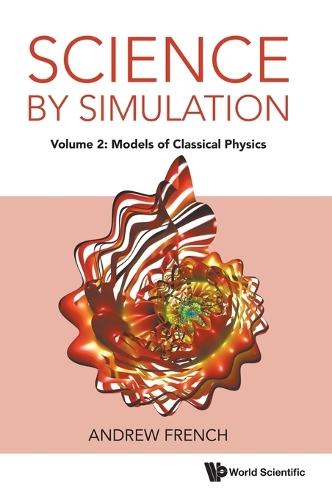
Science By Simulation - Volume 2...
Models Of Classical Physics
Hardback
$375.95 $300.45
Not in-store but you can order this
Dimensional Analysis Across the...
Classic Results, Textbook Examples,...
Paperback
$103.95
Not in-store but you can order this
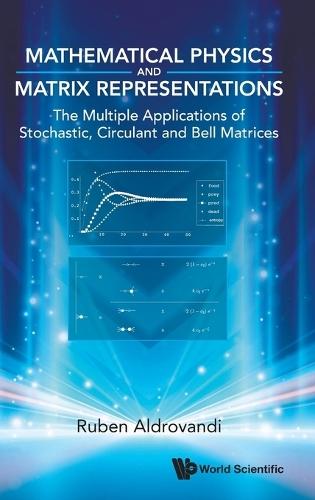
Mathematical Physics And Matrix...
The Multiple Applications Of Stochastic,...
Hardback
$429.95 $343.74
Not in-store but you can order this
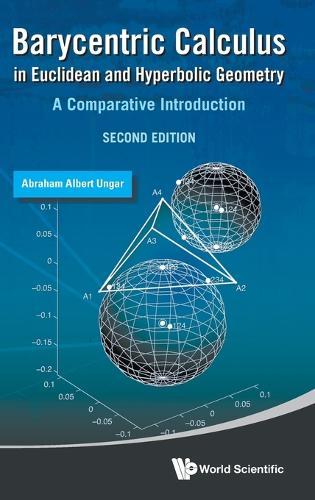
Barycentric Calculus In Euclidean...
A Comparative Introduction
Hardback
$375.95 $300.45
Not in-store but you can order this