Bargains! PROMOTIONS


R. K. Farrin is Professor of Arabic at the American University of Kuwait. He is the author of Abundance from the Desert: Classical Arabic Poetry (2011) and Structure and Qur'anic Interpretation: A Study of Symmetry and Coherence in Islam's Holy Text (2014), as well as numerous articles on classical Arabic poetry and the Qur'an.
'Farrin's The Early Qur'an in Mecca is a work of excellent scholarship written with insight and with the utmost clarity. It draws deftly on a wide range of earlier scholarship, gives ample consideration to the presence of apocalyptic ideas in the Qur'an, and makes the best case I have yet seen for establishing the chronology of Qur'anic surahs on the basis of stylometry, a hypothesis about which I have long been skeptical, but which I now will have to reconsider. This is an important work that deserves the attention of all students of the Qur'an.' Fred M. Donner, Peter B. Ritzma Professor Emeritus of Near Eastern History, The University of Chicago 'A fascinating and erudite treatment of apocalypticism, Farrin's study combines detailed, rigorous analysis of a nucleus of 50 suras with surefooted treatment of the texts and history of the late antique Near East to convincingly argue that the early Meccan Qur'an fits squarely into an apocalyptic mold. Sure to be of interest to the specialist and generalist alike, The Early Qur'an in Mecca: Apocalyptic Expectation at the Dawn of Islam graphically conveys the charged atmosphere that prevailed at a time when, it seems, nearly everyone was expecting the imminent end of the world.' Alyssa Gabbay, Associate Professor Emerita, Religious Studies, The University of North Carolina at Greensboro 'Calmly operating across some entrenched scholarly frontlines, Farrin gives us a nuanced and multi-faceted examination of the oldest layer of Qur'anic texts, which convincingly centres their foundational message of eschatological warning.' Nicolai Sinai, Professor of Islamic Studies, University of Oxford 'The Early Qur'an in Mecca sheds new light on Islam's emergence and the urgent eschatological vision at its dawn. This erudite and original study makes an invaluable contribution to Qur'anic studies and to the study of Islam's origins in late antiquity.' Bilal Orfali, Sheikh Zayed Chair for Arabic and Islamic Studies, American University of Beirut
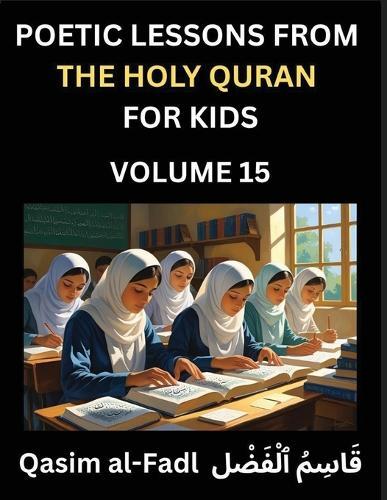
Poetic Lessons from the Holy Quran...
Part 15 - The Whispers of the Divine...
Paperback
$61.95 $52.34
Not in-store but you can order this
The Holy Quran - Verbatim
An Innovative Translation
Paperback
$46.95 $39.98
Not in-store but you can order this
The Integrity of the Qur'an
Sunni and Shi‘i Historical Narratives...
Paperback
$57.99
Not in-store but you can order this
The Glorious Quran
Easy English Translation Juzz 11...
Paperback
$19.95
Not in-store but you can order this
Poetic Lessons from the Holy Quran...
Part 22 - The Whispers of the Divine...
Paperback
$61.95 $52.34
Not in-store but you can order this