PRIZES to win! PROMOTIONS


JOHN BRISCOE is a senior partner at Washburn, Briscoe &McCarthy in San Francisco, California.
There are many business and professional subjects that the modern surveyor is required to be competent in or knowledgeable about in order to be successful (let alone licensed). There are ancient and fundamental issues such as making and analyzing measurements and conducting research for boundary location. There are business issues such as new developments in software and equipment. Lastly, there are practice issues related to governmental agencies such as local land development regulations or state wetlands rules. Good training is available on all of these topics. But there is one subject in the business of land surveying that receives much press, in this magazine and others, that for which one can find little, if any training-that is, testifying in court, and the related workings of courts. <p>Surveyors on the Witness Stand Surveying the Courtroom was written with two primary objectives in mind. First, to give the reader an acquaintance with courtroom rules and procedures for handling evidence, and the second, to show and explain how well engineered the legal process is for determining facts and resolutions. The author is a California attorney who seems to sincerely enjoy his work. He writes with enthusiasm and wit and displays open admiration for the capability of legal proceedings to find and solve problems. His examples are well-chosen and the sometimes humorous quotes he includes from literary figures and famous jurists keep the presentation of the technical material lively. The book may have come to your attention in the past. It was originally published by Landmark Enterprises back in the 1980s and was regarded then as a book specific to California. The author tells us in the current edition that due to a wider adoption of federal rules of evidence by more states, the book is now applicable in 40 of the 50 states. The states that do not adhere to the rules and procedures described in the book are Connecticut, Massachusetts, New York, Georgia, Pennsylvania, Kansas, Illinois, Missouri, New Jersey, and Virginia. Even though I reside and practice in one of the states that does not use federal rules, I found the book to be nonetheless useful and enlightening. <p>Two Main Sections <p>Surveying the Courtroom is divided into two main sections. The first is on the rules of evidence and the second is on the procedures of civil cases. The section on rules of evidence contains chapters onrelevance, documentary evidence, hearsay, personal knowledge, proof, presumptions, privileges, judicial notice, and opinions. The section on civil trials has chapters on pleadings and motions, discovery, trial, and post trial proceedings. It also has appendices on depositions and certification of documents. This is an immense amount of material to be contained in a mere 200 pages. However, the author states clearly that his goal is to have surveyors become more acquainted with the courtroom, not to become experts on it. Most of us would be satisfied with just a simple understanding of the activity taking place around us. It is the general explanation of how courts and lawyers operate that makes this book so appealing to me. Its specifics may not apply to my state but the generalities do. After reading it I have a better idea of what is happening and why, and I can ask more informed questions of the lawyers on my side. After all, I know how the city council does its business and I understand the role of various boards and commissions in land development work. Why shouldn't I have the same level of appreciation of the workings of the court? I think most licensed surveyors will find this to be a useful book to have around the office. -- Professional Surveyor Magazine, May 2001 Volume 21, Number 5 (Patrick Toscano is the City Surveyor for New Britain, Connecticut, and the Book Review Editor for the magazine)
Revise SQE Land Law 2025/26
SQE1 Revision Guide
Paperback
$53.95 $45.56
Not in-store but you can order this
Politics, Policy and Private Law...
Volume I: Tort, Property and Equity...
Hardback
$180
Not in-store but you can order this
A Practical Guide to Injunctions...
Paperback
$138.95 $111.50
Not in-store but you can order this
Acts of 30° & 43° Geo. III. Relating...
Paperback
$39.95 $34.21
Not in-store but you can order this
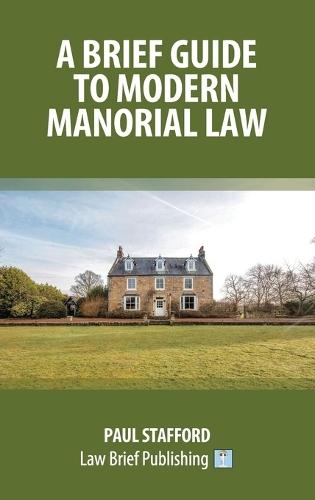
A Brief Guide to Modern Manorial...
Hardback
$352.95 $282.06
Not in-store but you can order this