Bargains! PROMOTIONS


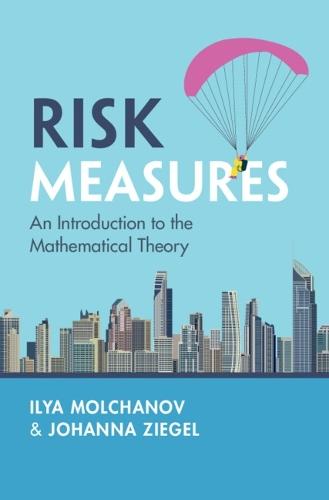
Ilya Molchanov is Professor of Probability at the University of Bern, having previously worked at the University of Glasgow. He specialises in stochastic geometry. He authored 'Theory of Random Sets' (2017) and co-authored 'Random Sets in Econometrics' (2018) with Francesca Molinari, discussing the econometric applications of his work at the interface between probability theory and convex geometry. Johanna Ziegel is Professor of Statistics at ETH Zurich, having previously worked at the University of Bern. Her expertise is statistical forecasting theory and applications, mainly in finance and meteorology.
'This book presents the one period theory of risk measurement or monetary utility functions. Since their introduction in the nineties, the theory and its applications have undergone a lot of changes. It is the right time to compile the advances in a new book. To benefit fully, the reader should follow the advice of Paul Halmos: to learn mathematics you must do mathematics and therefore should certainly solve the numerous exercises that accompany every chapter. Some of them are trivial, but not easy; some are intermediate. The last chapter puts emphasis on multivalued risk measurement which is a new development. The reader (solving the exercises) will learn a lot when studying this book.' Freddy Delbaen, ETH Zurich
Risk Measures
An Introduction to the Mathematical...
Paperback
$90.95 $77.24
Not in-store but you can order this
Business Statistics
For Contemporary Decision Making...
Loose-leaf
$323.95
Not in-store but you can order this
Advance SEO Strategies for Beginners...
Dive Deeper into Search Engine Optimization...
Paperback
$34.95 $31.86
Not in-store but you can order this
Practical Guide on Seasonal Adjustment...
Paperback
$67.95 $57.53
Not in-store but you can order this
Time Series for Economics and Finance...
Hardback
$343.95 $275.46
Not in-store but you can order this