PRIZES to win! PROMOTIONS


Dr. Jenny Magnes holds a B.S. in Physics and Mathematics from Delaware State University and a B.S. in English from the University of Maryland (European Division), as well as an M.A. and Ph.D. in physics from Temple University. She is currently serving as a professor and chair of the physics and astronomy department at Vassar College. Dr. Magnes has researched various areas involving optics: diatomic spectroscopy of alkalis, quantum optics, molecular optics, opto-mechanical techniques, nano-structures, and bio-photonics. She is interested in developing techniques that are beneficial during classroom interactions. She has also successfully involved undergraduates in her research, resulting in more than 16 peer-reviewed publications with undergraduates. Dr. Magnes and her research group dove into investigating micro-organisms using optical techniques like scattering and various interference effects involving iridescence. Dr. Magnes’s work on the locomotion of C. elegans was funded by the National Science Foundation. Currently, she is investigating the locomotory predictability of microorganisms using non-linear dynamics in the field of chaos and complexity. Juan M. Merlo-Ramírez is an Associate Professor in the Physics and Astronomy Department at Vassar College. He holds a five-year degree in Physics and an M.Sc. in Optoelectronics from the University of Puebla. In 2010, he earned a Ph.D. in Optics from the National Institute of Astrophysics, Optics, and Electronics (INAOE) in Puebla, Mexico, with a dissertation on near-field microscopy. His current research focuses on two main areas: (1) near-field microscopy and plasmonics, where he studies light–matter interactions at the nanoscale, and (2) topological phases of matter in classical systems, with an emphasis on photonic and mechanical topological insulators. He is also interested in disseminating scientific knowledge by writing science books for children.
Visible Light Communications (Second...
Vehicular applications
Hardback
$353.95 $283.36
Not in-store but you can order this
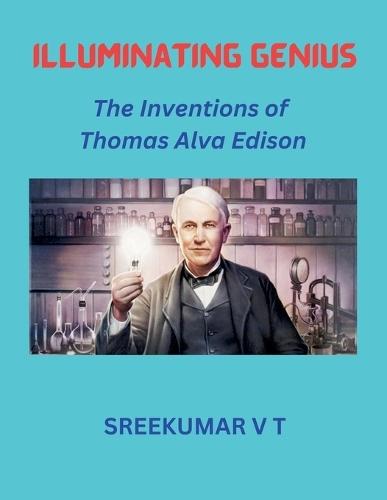
Illuminating Genius
The Inventions of Thomas Alva Edison...
Paperback
$58.95 $50.18
Not in-store but you can order this
Introduction to Semiconductors
From Materials to Devices
Hardback
$221.95 $177.72
Not in-store but you can order this
Proceedings of the 10th IRC Conference...
IRC-SET 2024, 17 August, Singapore...
Paperback
$490.95 $392.41
Not in-store but you can order this
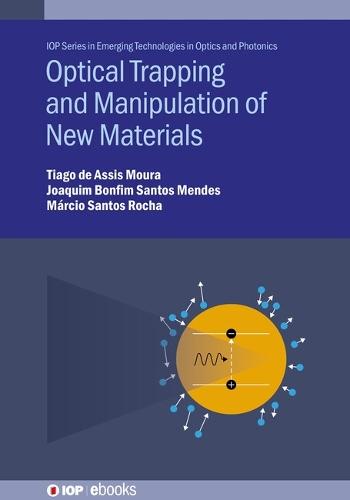
Optical Trapping and Manipulation...
Hardback
$353.95 $283.36
Not in-store but you can order this
Millimeter Wave and Terahertz Devices...
Modern Design Aspects and Optimization...
Hardback
$564.95 $452.05
Not in-store but you can order this