Beat the rise! Delivery fees are going up soon. INFO


Qingming Huang is associate research fellow at the Institute for Development and Governance, the Chinese University of Hong Kong, Shenzhen.
Why did South Korea experience regime changes in the 1960s and 1980s, but North Korea did not? Using original sources in Korean, Dr. Huang compellingly demonstrates how North Korean leaders outperformed their South Korean rivals in constructing a founding myth and establishing a monopoly of nationalism during the early period of state and regime formation. The North Korean regime’s success in its legitimation strategy contributed to its stability whereas South Korea was plagued by political upheavals throughout the 1960s-1980s. This book breaks away from most studies of North Korea that mythicize the North Korean regime and offers an illuminating comparison of the two Koreas. It is an impressive and valuable book for students of modern Korea, postcolonial Asia, comparative nationalism and comparative authoritarianism. -- Tuong Vu, University of Oregon, USA This important study breaks new ground by comparing the attempts of North Korea and South Korea to use their educational systems to construct regime-legitimizing founding myths. The book will be of interest to specialists in Korean politics and history, as well as to scholars of authoritarian resilience in communist and noncommunist regimes. -- Martin K. Dimitrov, Livingston Family Chair in Political Science, Tulane University, USA This groundbreaking book offers an unprecedented lens on inter-Korean dynamics by weaving together historical depth, contemporary analysis, and cultural insight. With clarity and rigor, it illuminates the complexities of division and dialogue, bridging scholarly precision with accessibility. Unique in its interdisciplinary scope and balanced perspective, it stands as an indispensable guide for anyone seeking to understand the Korean peninsula’s past, present, and future. -- Sang Hwan Seong, Seoul National University, South Korea
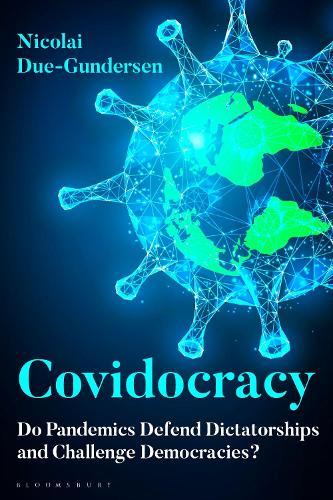
Covidocracy
Do Pandemics Defend Dictatorships...
Hardback
$130
Not in-store but you can order this