PRIZES to win! PROMOTIONS


From the reviews: ""There has been increasing interest in recent years in the synthesis and study of materials structured on the nanoscale and mesoscale. This two-volume treatment by Muhammad Sahimi of complex, disordered materials is thus particularly timely. … The second volume also pays significant attention to fracture in heterogeneous materials. … It is likely that this material will be of greatest interest to scientists in physics, engineering, chemistry, and materials science. … well written in an accessible and readable style with detailed descriptions of the models … ."" (Ward H. Thompson, MRS Bulletin, Vol. 30, February, 2005) ""The book is divided into two volumes. … Volume II contains an extensive collection of nonlinear models, including models of fracture and breakdown and atomistic models. … is well organized, contains necessary details and explanations and discusses predictions of the models … . a useful contribution to the literature devoted to inhomogeneous materials. It can be recommended to a wide range of readers: from actively working investigators in the field … to engineering students (as additional reading related to material science courses)."" (Alexander G. Kolpakov, Mathematical Reviews, 2004e) ""The second volume of this multidisciplinary book deals with the study of transport processes in nonlinear heterogeneous materials. One derives effective properties of disordered materials providing constitutive nonlinearities … . This multidisciplinary book is recommended to materials scientists, chemical and mechanical engineers, and applied physicists and mathematicians."" (Olivian Simionescu, Zentralblatt MATH, Vol. 1028, 2004) ""The second volume of Sahimi’s magnum opus deals with nonlinearities in the behavior of heterogenous materials. … Apart from basic concepts and experimental techniques, the continuum and discrete approaches to fracture are considered in great detail. …Sahimi’s two books … present an exhaustive account of the developments in heterogeneous materials research. They are outstanding contributions in the field."" (Eva Gregorova, Materials World, Vol. 13 (12), 2005) ""There has been increasing interest … in the synthesis and study of materials structured on the nanoscale and mesoscale. This two-volume treatment by Muhammad Sahimi of complex, disordered materials is thus particularly timely. … this material will be of greatest interest to scientists in physics, engineering, chemistry, and materials science. The books are well written in an accessible and readable style with detailed descriptions of the models and derivations of the theoretical approaches. … useful for graduate students and researchers beginning in the field … ."" (Ward H. Thompson, MRS Bulletin, Vol. 30, February, 2005) ""This book covers several major properties of heterogeneous materials … . The book will be quite useful for engineers working on composite materials; it will allow them to look into not only the optical properties of these materials, but also their mechanical and thermal characteristics."" (Hiroshi Mataki, Optics & Photonics News, Vol. 16 (10), 2005)
Round-Robin Test on Creep Behaviour...
Experimental Program, Results and...
Hardback
$236.95 $189.29
Not in-store but you can order this
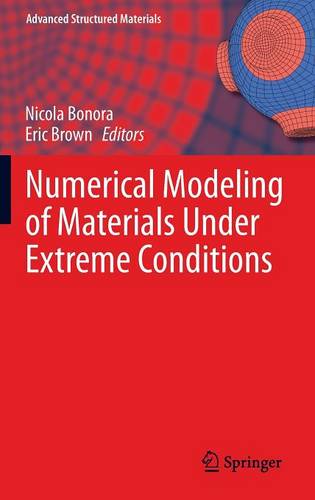
Numerical Modeling of Materials...
Hardback
$251.95 $201.58
Not in-store but you can order this
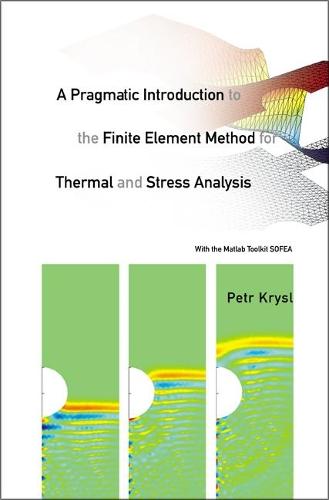
Pragmatic Introduction To The Finite...
With The Matlab Toolkit Sofea
Hardback
$268.95 $215.17
Not in-store but you can order this