Bargains! PROMOTIONS


'What a great book! It refreshes the parts that other GR books don't reach - action principles, causal structures, and the canonical formalism - all told with wonderful clarity of exposition.' David Tong, University of Cambridge 'A beautifully clear and detailed exposition of General Relativity, with every key derivation carefully presented to guide the reader from foundations to modern developments.' V. Mukhanov, LMU Munich 'This carefully written text covers the foundations of the subject with mathematical rigor and clarity while at the same time offering a choice of advanced and often distinctive topics, not usually found in textbooks. It can become a valuable resource for graduate students, especially those interested in the view of the subject from a field/string theorist's perspective, and will serve as an excellent reference book for researchers interested in different aspects of gravity.' Ruben Minasian, Institut de Physique Théorique, CEA Saclay 'It was a delight to read Piljin Yi's 'Gravitation for Theorists. The book starts from the basics, including special relativity, and then develops the subject in modern language, introducing all the tools along the way. It covers all the basic aspects of general relativity and its applications that are taught in the standard graduate course in gravity, and then goes on to discuss advanced topics like canonical formulation of gravity and black hole thermodynamics that can serve as an opening to the study of quantum gravity. I expect that this will become a standard textbook for theoreticians and experimentalists alike.' Ashoke Sen, International Centre for Theoretical Sciences 'This book offers a remarkably clear and systematic pathway from the foundations of electromagnetism and special relativity to the full structure of general relativity. Piljin Yi combines mathematical precision with physical insight, guiding the reader with exceptional clarity. The careful derivations, abundance of worked examples, and emphasis on geometric structure make this volume ideally suited for graduate students and researchers seeking a coherent and self-contained introduction to modern gravitational theory.' Hirosi Ooguri, Caltech
Introduction To General Relativity...
Hardback
$429.95 $343.74
Not in-store but you can order this
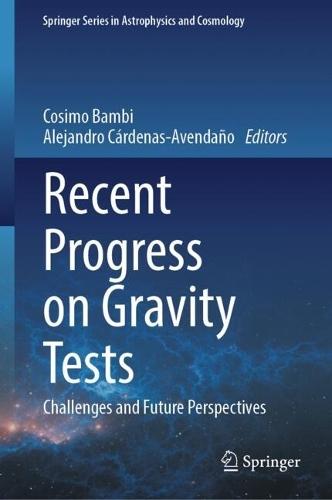
Recent Progress on Gravity Tests...
Challenges and Future Perspectives...
Hardback
$340.95 $273.14
Not in-store but you can order this