PRIZES to win! PROMOTIONS


Daniela Stockmann is Director of the Centre for Digital Governance and Professor of Digital Governance at the Hertie School. She holds degrees from the University of Michigan, Ann Arbor (PhD 2007), the School of Oriental and African Studies at the University of London, and the University of Rochester. Before joining the Hertie School, she was Associate Professor of Political Science at Leiden University. Her book, Media Commercialization and Authoritarian Rule in China (Cambridge University Press, 2013), received the 2015 Goldsmith Book Prize by the Harvard Kennedy School Shorenstein Center. Beyond her academic work, she has served as advisor on social media governance to policy-makers in the Netherlands, Germany, and the United States. Ting Luo is Associate Professor in Government and Artificial Intelligence at the University of Birmingham. Her research focuses on the intersection of technology and governance, with a particular emphasis on digital and AI governance. Prior to joining the University of Birmingham, Ting was senior lecturer in Political Communication at Manchester Metropolitan University and post-doctoral fellow at the Hertie School in Berlin and Leiden University in the Netherlands. She holds a Ph.D. in government and a Master of Science in public policy and administration from LSE.
'Governing Digital China offers a compelling analytical framework to understand the intricate relationship between the state, platforms, and citizens in shaping digital governance in China. It challenges the conventional account China's top-down policies and develops a novel theory of 'citizen-influenced corporatism' shaping China's platform economy. A fascinating read!' Anu Bradford, Columbia Law School and the author of Digital Empires 'Understanding China's current data policies will be critical to anticipating global trends in the information environment in the years ahead. Stockmann and Luo, two experienced analysts of digital China, give us both the theoretical frame for understanding how the country's model for data management has emerged, and the tools needed to explain the impact of the model on governments, markets, and citizens around the world.' Phil Howard, Oxford Internet Institute and Chair of the International Panel on the Information Environment 'Governing Digital China is a groundbreaking work that illuminates China's digital strategy through extensive research. Stockmann and Luo introduce 'popular corporatism,' a model of state-tech giant collaboration for online control and innovation. Dismantling misconceptions, the authors reveal regional variations and tensions within this nuanced approach. This insightful book stands as the most comprehensive examination of digital China in the past two decades.' Yuhua Wang, Professor of Government at Harvard University
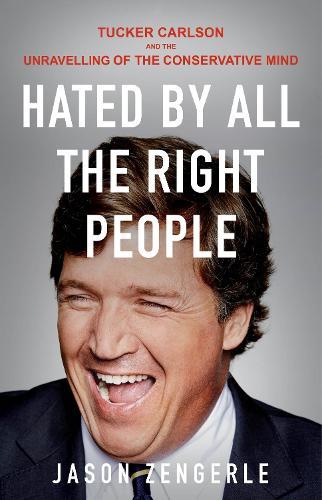
Hated by All the Right People
Tucker Carlson and the unravelling...
Paperback
$36.99
Not in-store but you can order this
The Men Who Killed the News
The inside story of how media moguls...
Paperback
$24.99
In Stock 😊