Beat the rise! Delivery fees are going up soon. INFO


Anuj Kumar obtained an M.Tech. in Instrumentation from the Indian Institute of Technology Kurukshetra in 2004 and a PhD in Embedded Systems from the Indian Institute of Technology Delhi in 2011. Between 2011 and 2015, he held posts as a Postdoc Fellow at the University of Seoul, the University of Pretoria, and the National University of Singapore. He has been working on devices to monitor indoor air quality and to tackle associated problems for the past 15 years. His research interests include sensing applications, wireless sensor-actuator networks, energy-efficient buildings, and the Internet of Things applied to building physics. Ram Gupta is a Professor in the Department of Chemistry at Pittsburg State University, Kansas, United States. His research focus is in green energy production and storage using nanomaterials, optoelectronics and photovoltaics devices, organic-inorganic heterojunctions for sensors, nanomagnetism, conducting polymers and composites as well as bio-based polymers, bio-compatible nanofibers for tissue regeneration, scaffold and antibacterial applications, and bio-degradable metallic implants.
DIY Solar Projects for Beginners...
Small and Easy Projects to Whole-Home...
Paperback
$29.99
Not in-store but you can order this
Biofuels from Lignocellulosic Materials...
Paperback
$419.95
Not in-store but you can order this
Vegetable Oil in Energy, Volume...
Biofuel Technology
Paperback
$314.95
Not in-store but you can order this
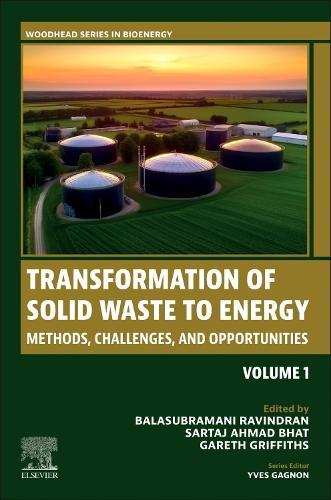
Transformation of Solid Waste to...
Methods, Challenges, and Opportunities...
Paperback
$512.95
Not in-store but you can order this