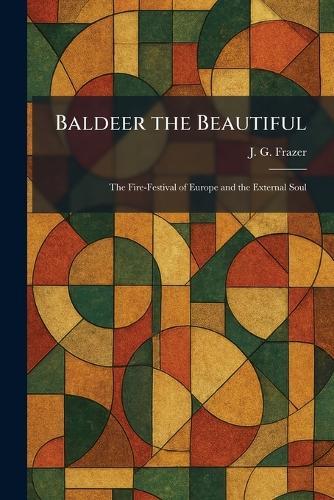
""Baldeer the Beautiful: The Fire-Festival of Europe and the External Soul"" is a seminal exploration of mythology, ritual, and the ancient roots of European folklore. Written by the renowned anthropologist Sir J.G. Frazer, this work constitutes a significant segment of his monumental study, ""The Golden Bough"". This volume focuses specifically on the Norse god Balder and the pervasive tradition of fire festivals across the European continent.
Frazer meticulously examines the symbolic power of fire and its role in seasonal rites, connecting these practices to the concept of the external soul and the preservation of life. Through a comparative lens, the text investigates how ancient human societies understood the relationship between the divine, nature, and the cycle of the seasons. By documenting various local traditions and legends, Frazer provides a comprehensive overview of how pagan beliefs survived through centuries of cultural change. This work remains a cornerstone of social anthropology and comparative religion, offering invaluable insights into the development of human thought, the nature of sacrifice, and the enduring power of myth in shaping cultural identity and social organization.
This work has been selected by scholars as being culturally important, and is part of the knowledge base of civilization as we know it. This work was reproduced from the original artifact, and remains as true to the original work as possible. Therefore, you may see the original copyright references, library stamps (as most of these works have been housed in our most important libraries around the world), and other notations in the work.
This work is in the public domain in the United States of America, and possibly other nations. Within the United States, you may freely copy and distribute this work, as no entity (individual or corporate) has a copyright on the body of the work.
As a reproduction of a historical artifact, this work may contain missing or blurred pages, poor pictures, errant marks, etc. Scholars believe, and we concur, that this work is important enough to be preserved, reproduced, and made generally available to the public. We appreciate your support of the preservation process, and thank you for being an important part of keeping this knowledge alive and relevant.