Beat the rise! Delivery fees are going up soon. INFO


Prof. Dr. Ali Mohamed Salah is a full Professor of Comparative Religion, holding a Ph.D. from the National University of Malaysia (2000). He serves as Imam and Khatib at Markaz al-Tawfiq al-Islami in Oslo, Norway, and is a member of the Norwegian Non-Fiction Writers and Translators Association (NFFO). An author of numerous works in Arabic, English, and Somali across the fields of Islamic jurisprudence, theology, comparative religion, and Somali history, he has delivered over one hundred recorded courses in Islamic sciences and participates regularly in international academic and religious conferences across Europe, the Arab world, Africa, and Southeast Asia. He is the founder of Iqra Academy, Oslo. Dr. Mohamad Hussein Moallin is a Somali academic historian and researcher based in Oslo, Norway. He is the author of the original Arabic work upon which this volume is based, completed in May 2010, examining the historical and civilizational dimensions of Arab cultural influence in Somalia across the medieval period. His scholarship draws on classical Arabic manuscripts, archival records, and oral historical sources to reconstruct the intellectual and cultural history of the Horn of Africa.
""Arabic written sources concerning the history of Somalia have long remained neglected or insufficiently utilised within the broader field of Somali studies. This work offers a carefully assembled account of the Arab dimension in Somali history, situating Somalia within the broader intellectual and religious currents of the Islamic tradition. By making this material accessible in English, the translation allows students and scholars who do not read Arabic to engage with a body of historical evidence that has often remained inaccessible. From the perspective of a scholar who has spent more than five decades engaged in the study of Somali history, the importance of such works cannot be overstated."" - Prof. Dr. Mohamed H. Mukhtar, Savannah State University, Georgia, United States ""The work represents a significant scholarly contribution to the study of Somali history and to the understanding of Somalia's longstanding intellectual and cultural connections with the Arab world prior to the colonial period. It provides students and researchers with valuable insight into the historical foundations of Somali civilization and its place within the broader Islamic cultural sphere. The work deserves careful attention from scholars and should be included among the recommended readings for postgraduate students studying Somali history and civilization."" - Prof. Abdurahman M. Abdullah ""Baadiyow"", Professor of Modern Islamic History; Author of Making Sense of Somali History ""This book addresses a significant dimension of the civilizational history of the Somali nation that has not received sufficient attention within established academic scholarship. It argues that Somalia was not merely a passive recipient of Arab-Islamic culture, but an active participant in its adaptation, development, and local production - a corrective to Orientalist interpretations that draws on the rich manuscript and intellectual heritage produced by Somali scholars. This work constitutes a significant scholarly contribution to Somali studies, offering a comprehensive interpretation of Somalia's civilizational role within its African, Arab, and Islamic contexts."" - Dr. Ambassador Mohamed Ahmed Sheikh-Ali ""Doodishe"", Ambassador of the Somali Republic to the State of Qatar ""The study of Somali intellectual history remains one of the most underserved areas within Islamic studies and African historiography. This volume reconstructs the sustained interaction between Somali communities and the wider Arab-Islamic world, restoring Somali scholarly life to its proper context within the broader Islamic ecumene. The book maps the architecture of knowledge circulation in the western Indian Ocean with a specificity that allows future scholars to build on it rather than repeat its conclusions. The catalogue of Somali Arabic intellectual production assembled here establishes a baseline from which future researchers can work. As someone currently engaged in the recovery and translation of Somali Arabic manuscripts, I regard this volume as a major step toward compiling and accounting for the sources."" - Mohamud Mohamed Awil, PhD Candidate, Department of History, University of Pennsylvania
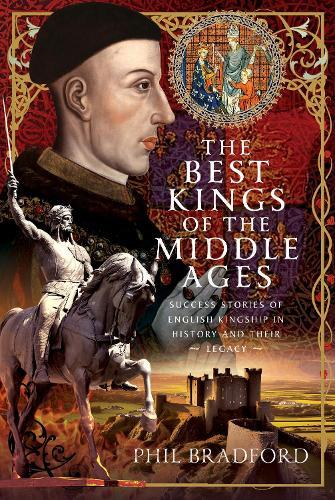
The Best Kings of the Middle Ages...
Success Stories of English Kingship...
Hardback
$80
In Stock 😊