Beat the rise! Delivery fees are going up soon. INFO


Jean Clobert is Research Director at the CNRS and is currently heading the ""Station d'Ecologie Exéprimentale du CNRS à Moulis"". He is also director of the Infrastructure ANAEE-S grouping all experimental research stations of the CNRS and INRA in France. Having published more than 250 regular papers in peer-reviewed journals and book chapters, he has been elected in the Academia Europaea in 2011. Michel Baguette is particularly interested by the role of dispersal in metapopulations and metacommunities. His objective is to seek how individual variability in dispersal moulds metapopulations and metacommunities and drives their dynamics and evolution, and what this means for biological diversity. His current research projects focus on (1) the genomic of dispersal phenotypic variation, and its consequences on metapopulation dynamics using artificial selection and experiments in mesocosms, and (2) the modelling of dispersal in fragmented landscapes. Tim Benton is a population ecologist with a particular interest in the mechanism by which environmental change impacts on population dynamics by affecting organisms' life histories. Much of his work has been conducted using a laboratory model organism, coupled with theoretical approaches. However, he has also applied his ideas to understanding biodiversity in agricultural landscapes. In addition to research, he has been head of department and Research Dean. He is currently working across the UK government, coordinating research on food and farming as ""Champion"" for the UK's Global Food Security programme. James Bullock is an applied ecologist. In his work he aims to use a fundamental understanding of the spatial ecology of populations and communities - especially of plants - to inform biodiversity conservation and environmental sustainability. He has particular interests in ecosystem services, ecological restoration and climate change. James works at the UK Centre for Ecology and Hydrology, which is the UK's Centre of Excellence for integrated research in terrestrial and freshwater ecosystems, and atmospheric science.
This book has great value for ecological theorists wishing to see modern work and examples from around the world on how dispersal ecology is studied, modelled, and now understood Steven N. Handel, Ecological Restoration This will be of interest to a broad readership, both as a reference text and as a source of stand?alone examples for biogeographers, ecologists, evolutionary biologists and geneticists alike, whether they be working on theory or generating empirical data Frontiers of Biogeography A thoughtful synthesis of a broad range of literature, incorporating both empirical and theoretical studies. Sara L. Goodacre, Frontiers of Biogeography. Dispersal Ecology and Evolution leaves little doubt that understanding dispersal is essential to understanding many questions in theoretical and applied ecology and evolution. It is highly recommended as a valuable source of knowledge and ideas for any graduate student or professional researcher from the fields of evolutionary biology, ecology, animal behaviour, genetics, population dynamics, or conservation. Trends in Ecology and Evolution
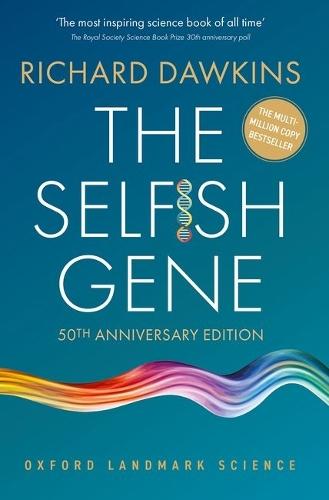
The Selfish Gene
50th Anniversary Edition
Paperback
$30.95
Not in-store but you can order this