Beat the rise! Delivery fees are going up soon.


Fabrice Lehoucq is a Professor of Political Science at the University of North Carolina Greensboro. He is the author of Stuffing the Ballot Box (2002) and The Politics of Modern Central America (2012) both published by Cambridge. He has received fellowships from the Helen Kellogg Institute, the Alexander von Humboldt Foundation, and the National Endowment for the Humanities. He was Book Review Editor for the Latin American Research Review (2016–24).
'Why have some Latin American countries experienced so many military coups? The Coup Trap in Latin America brings innovative new methods to an old and important question about dictatorship and democracy in the region. It also provides a compelling new answer. I highly recommend it.' Steve Levitsky, David Rockefeller Professor of Latin American Studies, Harvard University 'Fabrice Lehoucq's revelatory The Coup Trap in Latin America is a splendid combination of imaginative conceptualization, compelling theory, and painstaking research. It draws on a comprehensive data set on the more than 320 attempts to topple regimes throughout Latin America by their own military forces since 1900, almost half of which succeeded. It also draws on equally painstaking work to establish narratives of how those coups were put together and how they succeeded or failed. It is an inspiring model of joining a big overall picture established by a quantitative analysis to a splendid collection of miniature portraits of individual coups that show the social processes that produce the statistical regularities, or that violate those regularities as actors take their time in actually making the coup the statistics predict or make a coup despite a negative prediction. It shows instability to be more than a regional statistical norm but a trap that is difficult to climb out of, making the rare cases of long-enduring democracy and even rarer cases of long-enduring authoritarianism especially worthy of explanation. This book challenges many claims in previous literature, on such things as the significance of economic circumstances or the role of foreign actors. It is also very engagingly written. I would expect anyone writing on coups from now on to be drawing on this exciting work, or to be grappling with debating it.' John Markoff, Distinguished University Professor of Sociology, Emeritus, University of Pittsburgh 'A highly original study, combining ambitious scope, meticulous detail, and thought-provoking conclusions. Lehoucq's deft deployment of dense empirical data alongside rigorous statistical analysis has produced a book from which even traditional – statistically shaky – historians will learn a lot about a key feature of modern Latin American politics.' Alan Knight, Emeritus Professor of the History of Latin America, Oxford University
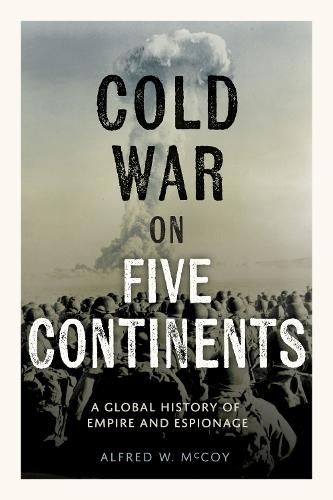
Cold War on Five Continents
A Global History of Empire and Espionage...
Hardback
$59.99
In Stock 😊